You are reading:
You are reading:

29.12.25
8 minutes readSend your questions to:
Director of
the Agirre Lehendakaria Center and scientific director of the Work4Progress
programme
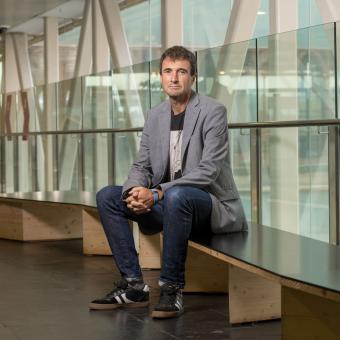
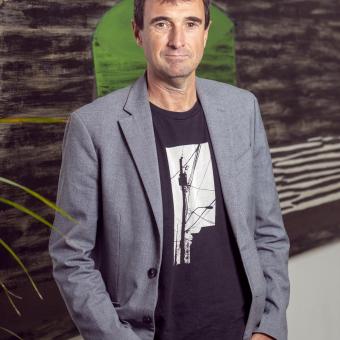
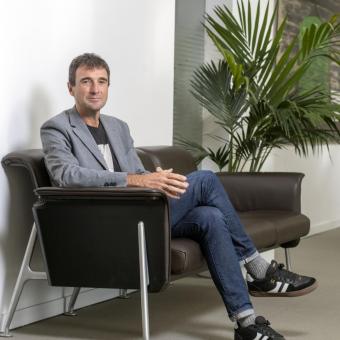
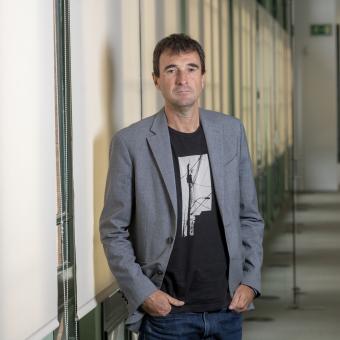
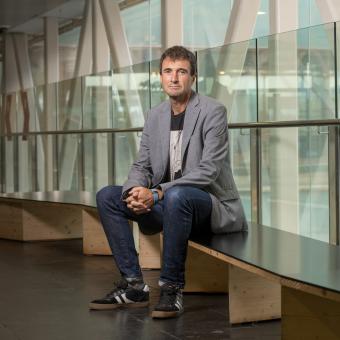
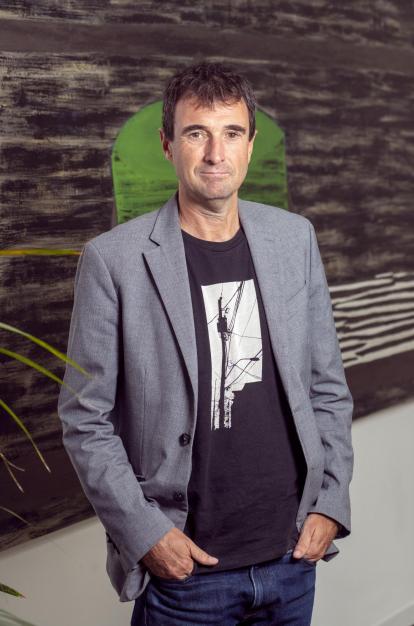
Gorka Espiau advocates for a different way of tackling development challenges: through genuine innovation, local participation and collective learning. A doctor in social sciences, he is director of the Agirre Lehendakaria Center (EHU), adviser to the European Commission and scientific director of Work4Progress, an international programme of the ”la Caixa” Foundation that helps create quality employment in rural areas of Colombia, India, Mozambique and Peru, particularly for women and young people. We spoke to him in Barcelona, where he attended the programme’s annual meeting and moderated a round table on digital social innovation.
The Western approach to cooperation – assuming that we bring solutions to places that don’t have them – still persists, even though we know it no longer works. And that logic breeds inequality. Work4Progress is conceived as a social innovation platform: a shared learning space where all the stakeholders contribute and learn, and where the common good is the goal. It’s not about launching isolated pilot projects whose results are difficult to scale, but about carrying out interconnected innovation experiences.
Social innovation emerges as a response to a reductionist view of innovation focused solely on technology or business. It’s about responding differently – and better – to social needs, whether current or emerging, through new products, services or processes. What interests us is how societies learn to respond collectively to complex problems, in our case, the creation of employment in rural areas. The kind of innovation we’re interested in goes to the root of the problem: it’s not looking for quick wins or successful start-ups, but real impact.
In India, we work with a cooperative that provides safe transport for women to help avoid situations of insecurity on their journeys to work. They themselves purchase the vehicles – electric rickshaws – and run a taxi service designed specifically for women, solving a problem that had been clearly identified. In Peru, we connected agricultural producers with Michelin-starred chefs. Their production processes improved to meet the needs of the restaurants. Today, some of their products, such as cheese, are sold in the establishments of the renowned Peruvian chef Gastón Acurio.
What we’ve discovered is that the differences between countries aren’t as great as we might think, because the challenges are similar. For instance, one of the main difficulties in creating employment in rural areas is that young people don’t want to stay in the countryside, something that happens in Mozambique just as it does in Catalonia or the Basque Country. That doesn’t mean you don’t have to build mechanisms for interaction that are adapted to each culture, but the goal remains the same: to understand needs from within. No project that isn’t built from within the communities themselves will succeed.
We collect local narratives – problems, aspirations, opportunities – and organise them into ethnographic profiles that reflect how different groups see reality. This allows us to know whether an initiative is aligned with the community’s perceptions. Sometimes their ideas don’t match objective data, but those perceptions influence the success or failure of a project more than the circumstances themselves, because reality is socially constructed.
Work4Progress has attracted a great deal of interest because it has a very systematic way of incorporating this cultural dimension into development processes. The challenge now is to make the most of digital tools so that listening and co-creation can be more agile and so we can gather more information. And here, the ”la Caixa” Foundation has made a significant commitment that could become a global benchmark.
We’ve digitalised all the information from the projects, and this will allow us to use artificial intelligence to analyse better what’s happening and to run simulations. For example, we’ll be able to interact with a bot that represents the specific aspirations of young women in the state of Uttar Pradesh in India, and ask whether a particular initiative makes sense for them. We’ll also be able to simulate intervention scenarios in specific areas, such as the Andean regions of Peru. It’s not about replacing human work, but complementing it and improving decision-making. We believe that this type of technology needs to be integrated in a much more ambitious way.
We’ve realised that in those countries, the needs are so urgent that technology is adopted very quickly, without giving much thought to side effects. In the Global North, people are more cautious. Ideally, we should find a balance: make the most of the tools, but with critical awareness.
Technology doesn’t solve everything, but it certainly creates opportunities. Thanks to it, for example, we can learn from one another. In the north, we can see how these technologies are being applied in the south and how they might be scaled up. And, in countries in the south, practical solutions are being developed that handle large volumes of data, which in turn require infrastructures that are currently located in the north, such as the Barcelona Supercomputing Center. The key is to build that collaboration from the outset on genuinely equal terms.
The sector faces structural challenges: a lack of resources, outdated funding models, and competition between organisations that prevents collaboration. In development cooperation, we replicate the same logic used in traditional consultancy, which prioritises managerial efficiency but distances us from our main goal: impact. Some organisations are already transitioning towards platform-based approaches, trying to connect with other actors, create spaces for experimentation and embrace open innovation. The same applies to donors. Some still follow the old logic of counting how many jobs a programme generates without analysing the context, while others are beginning to look at the impact on the entire system.
Today, the European Commission’s main priorities are competitiveness and resilience. For us, there can be no competitiveness without social innovation. There’s extensive scientific evidence showing that a system cannot be competitive if it generates major social inequalities or isn’t sustainable from a human development perspective. And, on the other hand, we need to remember that resilience is also about building social capital: if we want to be resilient, societies must increase their collective capacity to respond to any crisis.
That’s why issues like cooperation, social innovation, competitiveness and resilience need to be addressed together, at the same table. Too often they’re discussed separately: the “serious table” of governments and businesses, and the “social table” of foundations and NGOs. That separation is outdated. For us, it’s crucial for programmes like Work4Progress to show that they can make a contribution to competitiveness and resilience through strategies that are more interesting than those proposed in traditional approaches. It’s a battle in the realm of ideas, but one that will be very important in the years to come.
The funding model based on the Silicon Valley myth – brilliant people, lots of money, magical solutions – still dominates, even though there’s no evidence to support it. It’s an extractive model that concentrates resources and fuels inequality. We need to challenge that archetype. Philanthropy such as that of the ”la Caixa” Foundation is key, but not sufficient on its own. I believe that in the coming years we’ll see more connections between the public, private and community sectors, in which organisations and institutions act as integrators, rather than sole problem-solvers.
Right now, the challenge is managing success. We started as a small experimental pilot, with a testing mindset, but the results have been very positive. That means we now need to be more rigorous in how we work and how we share knowledge. We must be very clear about what has worked and why. We have to focus more on impact: not just how many jobs have been created, but what kind of jobs, how they affect families and the community, whether they empower women and young people, whether they help dismantle structures of inequality… Counting jobs is useful, but what really matters is understanding whether those jobs are changing lives.
It depends on the context. In the Global North there’s a great deal of despair and a fear of losing wellbeing. In the Global South there’s more openness to change because there’s not so much to protect. To innovate, we need both radicalism and balance: solutions that get to the root of the problem, but are well designed and avoid negative side effects. Daily life can feel heavy sometimes, but seeing communities with fewer resources who genuinely believe change is possible makes you realise there are reasons to keep going. The Global South reminds us that our fears are tied to our privilege. And that compels us to act.