High-income households spend 18% more on private tuition in Spain
03.02.26
4 minutes read
This is highlighted by the study Shadow
Education in the Iberian Peninsula, promoted by the ”la Caixa” Foundation
Social Observatory in collaboration with the European Society and Education
Foundation. The research concludes that this extra academic support can amplify
educational inequalities, as it entails a higher opportunity cost for families with
fewer resources.
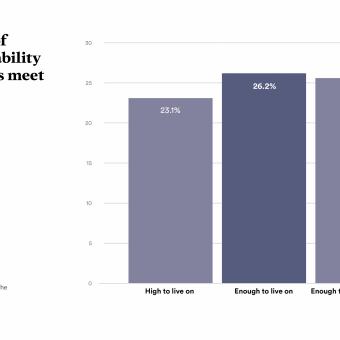
Households that report being more financially comfortable spend 18% more on private tutoring than those who say they struggle to make ends meet. This is one of the conclusions of the study Shadow Education in the Iberian Peninsula, published by the ”la Caixa” Foundation Social Observatory.
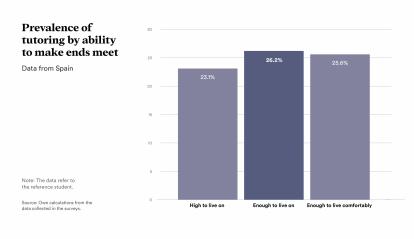
The study reveals a gap both in the likelihood of attending private tuition and in the amount spent on it, depending on families’ purchasing power. Consequently, the share of students who attend private lessons ranges from 23.1% in households with tighter finances to 25.6% in those with greater resources.This means that, although a significant proportion of families facing economic difficulties also resort to private tuition, spending on this resource entails a higher opportunity cost, as it may require reducing the household budget in other areas.
This research, which aims to explore in greater depth the reasons why families supplement formal education with additional classes and the characteristics of such tuition, was led and carried out by Juan Carlos Rodríguez, a professor at the Complutense University of Madrid (UCM) and PhD in Sociology, with the involvement of Mercedes Esteban Villar, Vice-President of the European Society and Education Foundation.
The 2024 survey was administered online to a sample of 2,500 parents or guardians in Spain with children aged 6 to 18 enrolled in primary education, compulsory secondary education or post-compulsory education.
Private tutoring as a factor in educational inequality
Given the potential impact of private tutoring on academic results, the research notes that unequal access to this type of extra support can amplify pre-existing educational inequalities, while also placing greater financial pressure on low-income families, who may end up devoting a larger share of their resources than wealthier households.
In fact, the researchers highlight that previous evidence shows family income and parents’ educational attainment play a significant role in their children’s academic performance. According to the EU Statistics on Income and Living Conditions (SILC) data for 2019, in Spain, children whose parents completed higher education have a 70% to 80% chance of also going on to higher education. In contrast, that probability falls sharply to below 30% among children whose parents did not complete lower secondary education.
An overview of extracurricular tutoring in Spain
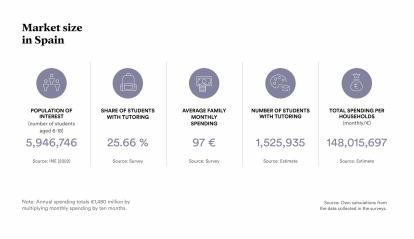
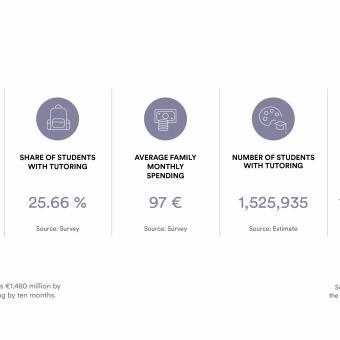
The research indicates that 25% of students aged 6 to 18 in Spain receive private tuition outside the formal education system. In absolute terms, around 1.4 million students in Spain were receiving supplementary educational support in 2024. On average, students spend three hours a week on this additional support, and the average monthly spend per student is 97 euros, with mathematics accounting for the largest share of that budget.
From an economic standpoint, the private tuition market in Spain is worth more than 148 million euros per month, which equates to roughly 1.48 billion euros per year.
Regarding the characteristics of this type of resource, the prevalence of private tuition varies significantly by educational stage. Its use is relatively low in the first cycle of primary education (13.2%), increases throughout compulsory schooling, and reaches its peak in upper secondary education (bachillerato) (35.6%). According to the authors, this higher frequency reflects the importance families attach to this stage, which is characterised by academic assessments with decisive implications for subsequent educational pathways.
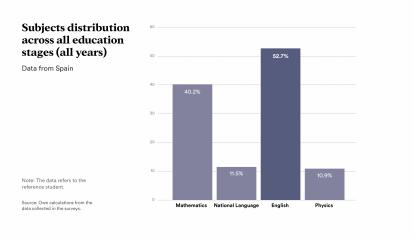
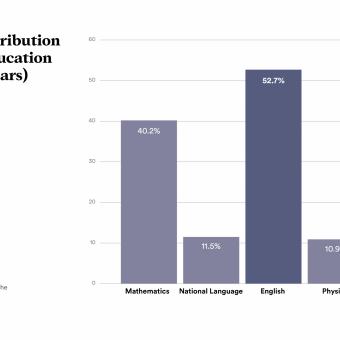
The survey highlights that the subjects most in demand for private tuition are English, which ranks first (52.7%), and Mathematics (40.2%), while Spanish language (11.5%), Physics (10.9%) and Chemistry (8.4%) show markedly lower percentages. In the latter subjects, access depends to a greater extent on attainment, unlike English. Most classes take place in educational centres (53.3%) and, to a lesser extent, in the student’s home (21.4%). The predominant format is group classes, which accounts for around 60% of cases, compared with one-to-one tuition, which represents 25.3%.
The main reason for enrolling a student in private tuition is that they are struggling with the subject in question (28.6%), followed by families’ limited ability to help their children at home (24.9%). Furthermore, students with special educational needs or behavioural difficulties also show a particularly high incidence, reaching as much as 48.8%.
These findings suggest that families primarily turn to this additional educational support as a complementary mechanism when students have difficulty achieving good academic results.
Compromís amb l’educació com a motor social
La Fundació ”la Caixa” té un ferm compromís amb l’educació com un dels motors socials més rellevants. A través de programes com CaixaProinfància desenvolupa i implementa un model d’acció social i educativa integral que contribueix a millorar les oportunitats de desenvolupament social i educatiu d’infants i adolescents en situació de vulnerabilitat amb eines com el reforç educatiu o l’equipament escolar. Igualment, mitjançant EduCaixa, posa a disposició dels equips directius de les escoles, el professorat i l’alumnat múltiples recursos per fer l’aprenentatge més ric, més significatiu i més integral.
- Imágenes
- Videos
- Audios
Madrid20.01.26“I got stuck, but I’d like my children to go further”
Every morning, in a flat in Puente Vallecas, Ainhoa Torres serves breakfast to her three children. She is 35 years old and has lived her whole life in the neighbourhood, one of the most disadvantaged areas of Madrid.
Read more