You are reading:
You are reading:
24.02.26
8 minutes readSend your questions to:
Professor of Economics at the Complutense
University of Madrid
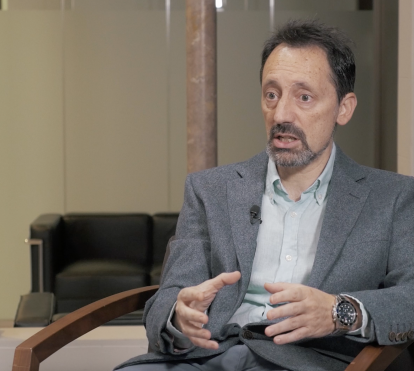
The rise of artificial intelligence (AI) is reshaping the world of work, as companies and public authorities struggle to keep pace. Who stands to gain and who stands to lose from this technological transformation? Juan Gabriel Rodríguez, Professor of Economics at the Complutense University of Madrid, has spent years studying how automation and AI affect wages in Spain. His latest research, supported by the ”la Caixa” Foundation Social Observatory, highlights that digitalisation is increasing inequality among workers and underlines the need to adapt in order to avoid a greater impact in the coming years.
Our study shows that technological change – and task automation in particular – has been a decisive factor in the evolution of the labour market over the past two decades. Its impact has been far greater than that of other factors, such as globalisation or educational level. And the effects are clear: automation and AI are increasing inequality. All the indicators we analysed point in that direction. It’s a structural phenomenon that cannot be ignored.
For the first time in history, a technology can replace not only routine tasks, but also creative ones. AI directly affects jobs that require a high level of training, something that had not happened until now. However, people with higher levels of education also have more tools to adapt to it and use it to complement their work rather than be replaced by it. As a result, they’ve become more efficient, and companies are seeking profiles like theirs.
In the healthcare sector, a doctor could be replaced by an algorithm capable of processing symptoms and delivering a diagnosis. However, it’s far more likely that the professional will use such a tool to form an initial picture and carry out a first analysis, and then apply their own judgement and experience to reach a diagnosis.
Automation is replacing jobs or pushing down wages in the segment of medium- and low-skilled employment. As a result, we’re seeing two simultaneous dynamics: at the upper end, there’s a complementary effect between technology and labour that drives wages upwards, while in the middle and lower segments, technological substitution puts downward pressure on wages.
AI is not being implemented in a uniform way, and there will probably be substantial differences between professions even when the required levels of training are similar. For example, we’re already seeing how technology is making it easier to create music and process images, which affects creative professionals to a greater extent. Our team is already comparing the impact of AI on the cultural industries with its impact in other fields, as everything suggests that their transformation will be different.
Young people are a very diverse group, so it’s hard to generalise. However, it’s important to stress that having digital skills doesn’t in itself enable them to work better with new technologies. Returning to the example of the doctor: interpreting the results processed by an algorithm requires in-depth knowledge of symptoms and diagnoses, something that simply knowing how a digital tool works doesn’t provide. To benefit from AI, you need experience, years in the profession.

The trickle-down effect is a classic economic theory which suggests that if technological change benefits those on higher incomes, wellbeing will eventually filter down to middle- and lower-income groups. What we’re seeing however is that this is a process with winners and losers, and if we want everyone to benefit from digitalisation, we need to introduce changes, because this trickle-down growth isn’t happening.
In recent years we’ve seen a significant shift of women into highly skilled jobs. This is due both to rising levels of education and to a radical change in stereotypes about the kinds of professions women typically held. However, many traditionally male-dominated jobs have been disappearing, and workers in these roles now earn less. The gender gap has narrowed as a result of these two trends, but we still can’t say with certainty how much is due to each one.
This is the most important unknown. Some studies argue that employment is increasing, while others suggest it’s falling; there’s no consensus among experts. The problem is that technology changes from one day to the next, there are different types of AI, and the impact varies across sectors. There’s a significant lack of data, which makes it very difficult to get an overall picture. We can’t know whether the most alarmist scenarios will come to pass, but we should be prepared in case they do.
It’s difficult to make a prediction, but the trend suggests that lower-skilled jobs requiring physical work, such as elderly care or hospitality, will not be replaced by algorithms, robots or software. What may happen, however, is that their wages stagnate. By contrast, in medium-skilled occupations it’s very likely that the process of technological substitution that began in the early 2000s will continue. And in the most highly skilled professions we’ll see differences depending on the sector: some activities will be more affected by AI than others, and everything will depend on professionals’ ability to adapt.
All of this points towards a scenario in which labour market polarisation and rising inequality will intensify. Some medium-skilled professionals who are displaced by automation will manage to move upwards, but most will fall into the lower end of the wage distribution. They’ll end up competing for jobs in that lower segment, which will put downward pressure on wages.
AI has caught virtually all countries off guard; the political response has been far too slow. Even so, some countries, such as the Netherlands, for example, have used Next Generation funds to reskill professionals who risk being left behind by this technological transition. We believe it’s not enough to offer courses to those who have already lost their jobs. The education system needs to be rethought from within, so that young people complete their studies with an understanding of the technologies that are changing, and will continue to change, the labour market.
The education system still has a nineteenth-century style, especially in Spain, where it’s quite rigid and subjects are compartmentalised, making it impossible to combine knowledge from the humanities and sciences, or from artistic and technological fields. Lifelong learning is also essential. I’m not talking about doing a one-year master’s degree, but about continuously devoting time to understanding how our jobs are evolving and how we can use new technologies to our advantage.
It would be advisable to review the tax system so that it’s as neutral as possible between capital and labour. At times, tax incentives encourage investment in technologies that do not always improve productivity, but are adopted because they’re more profitable. It would also be useful to create an institution to oversee and regulate the development of AI.
Various voices, such as that of Nobel Prize–winning economist Daron Acemoğlu, are calling for the creation of institutions of this kind. Their role would be, on the one hand, to encourage technological developments that are inclusive, for example, those in sectors with major productivity gaps, such as education, healthcare or business services. On the other hand, they would oversee the ethics of new technological advances in order to prevent phenomena such as discriminatory bias. The composition of such an agency remains to be defined, but it should include representatives from different sectors of society as well as experts capable of anticipating what lies ahead.
Companies aim to be efficient and to generate profits, so they’ll adapt to the system and respond to the economic incentives set by the public sector. To the extent that their workforces are more highly skilled, they’ll be better able to incorporate new technologies. That’s why companies will hire professionals whose training is better aligned with AI. Their role is more passive because, although they could take on part of the training, they run the risk of losing those workers once they become qualified.
Their role is different and highly relevant. On the one hand, they can alert society to the potential risks associated with new technological developments. On the other, they can convey the message that technology is here to stay and that, if we don’t act, others will. Their role is to be proactive and to steer technology so that it benefits society and becomes more inclusive.
Having a population that’s informed rather than frightened is crucial. A well-informed citizenry adapts better to change. But for that to happen, we need to make it clear that technology doesn’t affect all professions or all groups in the same way. In my own case, I ask myself how university education will change with the widespread adoption of generative AI applications. We need to internalise these changes not with fear, but with a proactive attitude. That’s the approach we should be encouraging.
I’d tell them that formal education is necessary, but not sufficient, and that they should actively look for modules, courses and programmes that complement the traditional system. I stress this a lot when I speak to my students: each person has to build their own professional profile. Those who succeed in doing so will be able to access better jobs and higher wages.