You are reading:
You are reading:
09.12.25
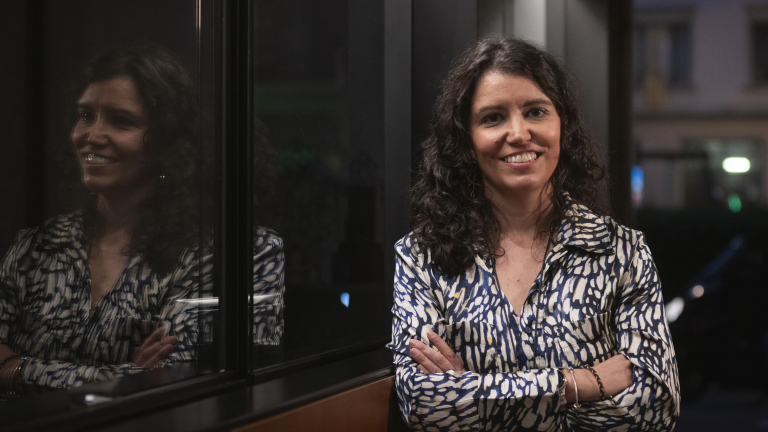
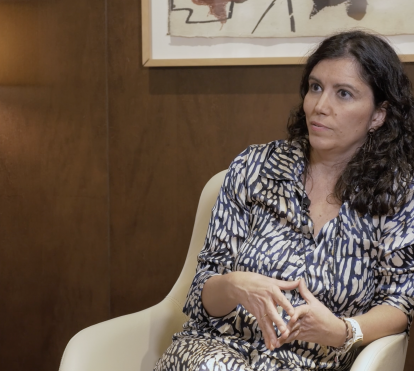
7 minutes readWith the awareness of someone who has spent years listening to adolescents and observing how technology shapes their daily lives, María Angustias Salmerón is one of the clearest voices on the impact of digital media on child development. A paediatrician specialising in digital health, she argues for the urgent need for all of us, not only children, to disconnect and demand a form of technology that, instead of capturing our attention, is truly at the service of human beings. We spoke with the expert following her participation in a debate on digital wellbeing and children held at the Palau Macaya of the ”la Caixa” Foundation.
The pandemic marked a very clear turning point, not only for adolescents but for the entire population. It was a period of tremendous stress that put many systems under strain, including child protection services. Although it would be simplistic to attribute the change to this single cause, it’s true that the general feeling is that “something’s happening”: we seem more irritable, on edge; kindness feels expensive, and there appears to be less respect in everyday life. And children are like sponges: they absorb what they see around them at home and out in the street.
The digital ecosystem is becoming increasingly complex. We’re no longer talking only about screens, but about all digital media: the Internet of Things, artificial intelligence… We see parents in the park looking at their phones, children in restaurants shut off behind a screen, and people walking down the street without paying attention to what’s around them. Social relationships are becoming ever more impersonal; face-to-face interaction is increasingly difficult. All of this affects us because we’re made to live in tribes, in contact with nature and doing physical work, yet we’re making things very hard for ourselves as a species.
The signs are varied. Physically, we’re seeing rapid increases in short-sightedness and cases of strabismus caused by having the screen too close for long periods of time. There’s also a very high impact on sleep, mainly because they take their phones to bed with them. When healthy habits such as sleep, physical exercise or diet are disrupted, that also affects mental health. We’re encountering children who consume pornography at very early ages and display behaviours that are not appropriate for their age, adolescents with very violent conduct, and various addictions, such as eight-year-old girls addicted to cosmetics, a condition known in Spanish as cosmeticorexia. The list of effects keeps growing.
The first studies on the effects of screens date back to the 1950s, coinciding with the arrival of the first televisions in people’s homes. What happened when a television was switched on in a living room? Well, people would usually fall silent. Those early studies warned about how this could affect social interaction. They also examined the effects on eyesight and how certain types of content affected people differently depending on their age.
Portability. In the past, you couldn’t carry a cinema screen in your pocket, but now we have devices that let us watch films and do many other things, anywhere. When the television was in a specific room in the house, the time spent in front of it was less. That’s why many paediatricians insist on bringing back the desktop computer: it’s far less likely that a child will use it without their parents’ supervision.
We know that neurodevelopment is based on two factors: an individual’s genetic capacity and the quality of the stimulus the child receives. And real-world stimulation – the physical world – is far richer than digital stimulation. If you put a child in front of a screen, they’ll receive immediate gratification just by moving a finger. In contrast, if they play with real materials they’ll probably look for a playmate, experiment with textures, temperatures, colours… In a single activity, they’ll be developing many different skills.
The Spanish Paediatric Association argues that there’s no safe screen-exposure time for young children, so the recommendation is: the later, the better. What I would say to parents is that they should ask themselves why they’re giving their child a mobile phone. Is there any alternative that would achieve the same result without handing over a latest-generation smartphone?
It’s often said that adolescents interact through social networks. I believe that what we actually interact with are the platforms, not the people. Except for instant messaging, on the rest of social networks we’re consuming content, clicking “like”, endlessly scrolling… It’s a system very similar to that of slot machines.

When the first studies on social media addiction appeared, they all raised the same question. It’s understandable that someone might become addicted to compulsive shopping, because access via the mobile phone is constant. But no-one is addicted to social contact. So why do people become hooked on social networks? Many adolescents believe they have lots of friends there, but in reality that’s not the case and, what’s more, they find it harder to build deep relationships. We see it out on the street: they meet up in person, but all they do is look at their phones. Often they’re not even talking to one another, each is absorbed in their own world.
When a parent gives their child a device “for safety”, the problem is usually the parent’s insecurity, not the child’s. If you feel they need to carry a mobile to go and buy a loaf of bread, it’s better not to let them go, because you probably believe they’re not ready yet. By doing this, we send a mixed message. The child will think: “Dad, do you think it’s dangerous to go outside?”
In my talks, I begin by saying that I’m going to “give people time”. I ask the audience to look at their daily hours of screen time and multiply it by 365 days. Then I ask them what they would like to do with all that time. Conscious digital disconnection is a concept that appears in the scientific literature and refers to becoming aware of one’s own digital consumption. We have devices designed to be carried in our pockets and we even go to bed with them. I think life is short enough and that we should ask ourselves what we want to do with our time.
The Spanish Paediatric Association has drawn up a set of recommendations for the whole family, starting with adults. These are scientific-evidence-based guidelines, such as avoiding screens at mealtimes, but also in bedrooms, to ensure proper sleep and greater safety, since it’s likely that an adolescent will not see certain things in the living room. They also include less obvious advice, like avoiding constant background noise, which has been shown to affect the development of immediate memory. The brain needs boredom and silence.
I refuse to believe that technology has to be harmful, but I do think that technology companies are not going to make changes to solve these problems voluntarily. The alternative is to legislate with measures similar to those we use with the pharmaceutical industry, where we require companies to prove that the products they put on the market are not harmful. I don’t know whether we’ll reach that point, especially given how quickly technology evolves, but children must be protected by default.
We cannot divide children into compartments. Their education is not the responsibility of the school, the family, the police or the neighbour; it’s the responsibility of society as a whole. Everything we do can be educational, or not. So how could the school not have an educational role? Just as we fight for school canteens to provide quality food, we should also aspire for schools to be screen-free spaces. There’s no study that has demonstrated any benefit to using screens in schools, but there’s plenty of evidence about their risks.
I would ask society in general to become aware of how much time it spends consuming digital content, and of what it chooses to pay attention to. I’m not anti-screen, but I do believe that the way technology has developed in recent years has given us tools that can be dangerous. That’s why I would ask technology companies to develop systems that are aligned with what human beings actually need and, above all, to be protective of children. A technology that adds value, that educates, that safeguards, and that truly serves society.