CaixaResearch Institute: architecture at the service of science and sustainability
24.04.26
7 minutes readThe project is one of the most ambitious undertaken by the ”la Caixa” Foundation and it will involve an investment of 100 million euros. Its design, which has become a major architectural challenge, was entrusted to TAC Arquitectes. The building stands out for its innovation and sustainability, its careful integration into its surroundings, and for providing a space specifically designed for science and collaboration.
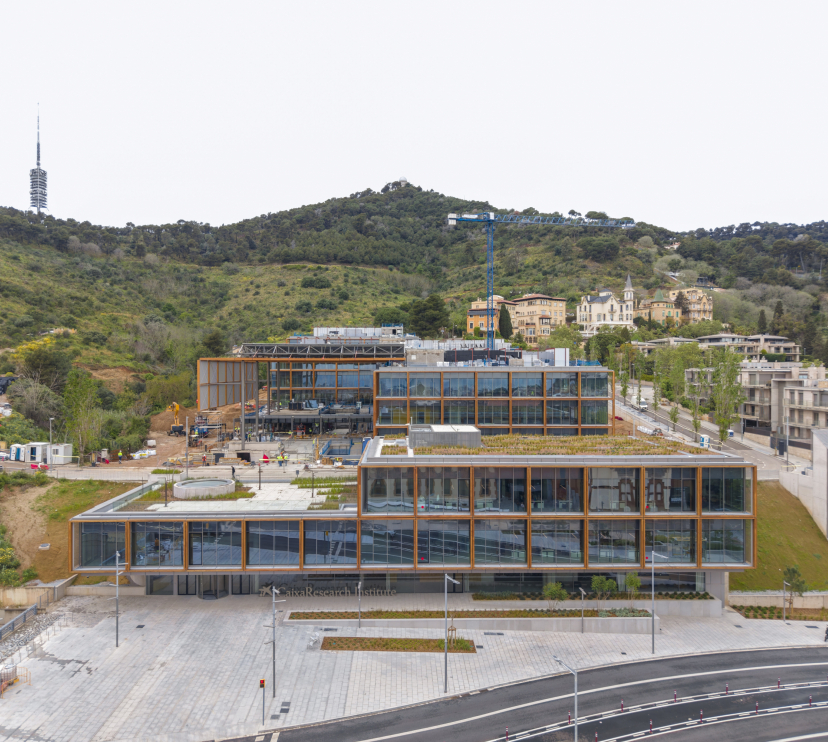
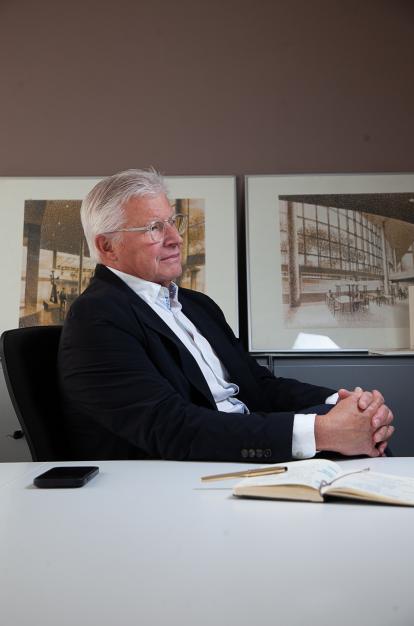
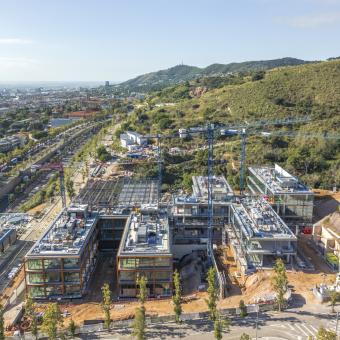
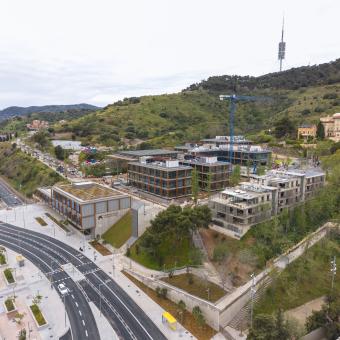
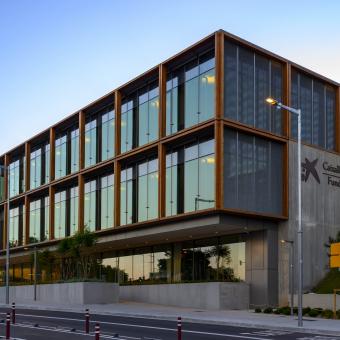
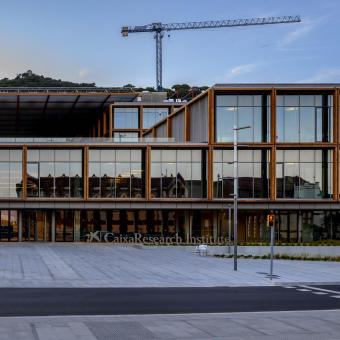
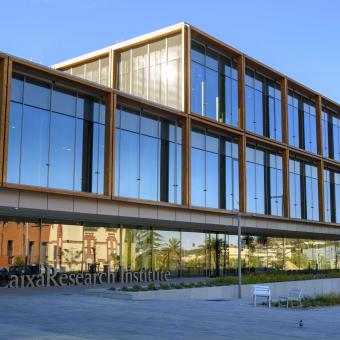
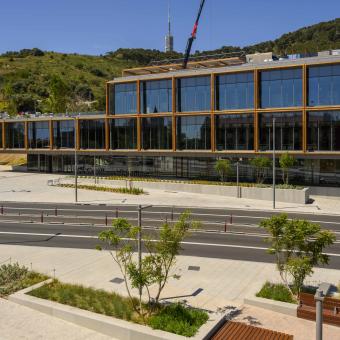
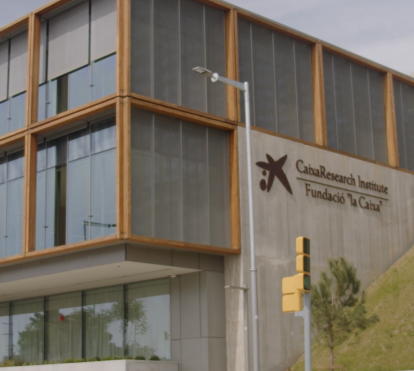
Every new construction project presents challenges, but in the case of the CaixaResearch Institute the greatest hurdle was to harmonise its function with the environment in which it was to be integrated. This approach became the first of the project’s two main objectives, undertaken by TAC Arquitectes under the leadership of Eduard Gascón: to construct the building in a privileged location in Barcelona, situated between the Collserola Natural Park, an area of great environmental value, and the Ronda de Dalt ring road. The second objective was to ensure that the space provided an appropriate architectural response to a highly technical and detailed programme, typical of a centre of research excellence.
In this context, the desire to place architecture at the service of science becomes particularly significant, with the building conceived as a tool that supports and enhances research. The facility has therefore been designed to accommodate the scientific advances of the future, driven by world-class researchers.
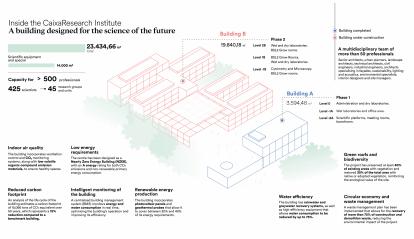
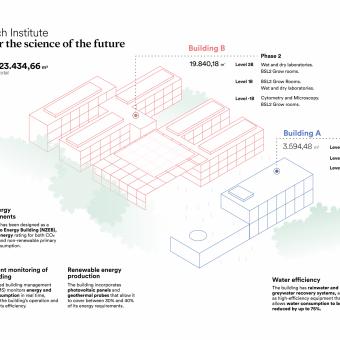
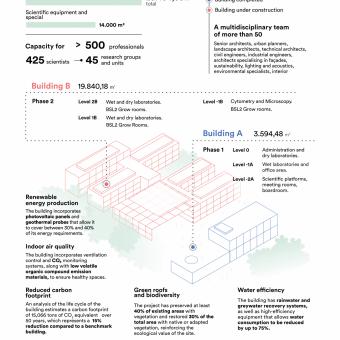
From a structural perspective, the building is divided into two modules: the one now being inaugurated and another whose opening is planned for a later phase of the project. In total, the usable floor area will be approximately 20,000 square metres.
In terms of layout, the key concept is that of “research units”: entities designed to operate independently, each comprising two large laboratories that share state-of-the-art technical equipment (machinery and sample preparation areas). These units are supported by extensive service spaces on lower levels, where facilities such as the biobank and systems for cooling and freezing samples and tissues are located.
In addition, the building also includes office space for management and administrative functions, as well as reception and visitor areas where events, training courses and networking initiatives will take place.
Another distinguishing feature is its flexible design. As the centre’s scientific activity grows, the space will adapt to its needs, with the capacity to expand progressively to accommodate up to 500 people. Furthermore, its open-design concept is intended to foster collaboration among researchers, thereby promoting innovation and knowledge transfer.
Innovation
and sustainability, hand in hand
A key requirement in shaping the CaixaResearch Institute was to achieve an attractive yet sustainable design. Its location at the foot of Collserola, the “green lung” of the Catalan capital, has led to the entire building being conceived according to criteria that prioritise energy efficiency and respect for the environment, with a clear commitment to the use of renewable energy.
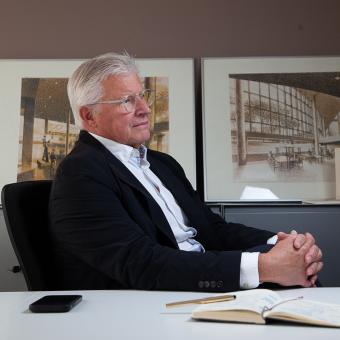
“Today we still talk about sustainability as a special requirement, as something novel, but in a few years’ time we won’t, because it will be built into every building as standard,” notes the architect. Notable among the measures adopted are the installation of geothermal probes for the production of cold and hot water for climate control, photovoltaic panels for electricity generation, and rainwater collection systems for irrigation and internal use. Together, these measures will enable a 38% reduction in energy consumption and a 40% reduction in water use. The key feature is that “it is a fully decarbonised building” and that, once fully operational, it will run “entirely on energy from renewable sources”.
A
scientific campus open to society
One of the missions of the CaixaResearch Institute is to bring its scientific advances and discoveries closer to the public. Its proximity to the CosmoCaixa Science Museum offers a unique opportunity to strengthen outreach initiatives and encourages the creation of an authentic scientific campus accessible to all audiences.
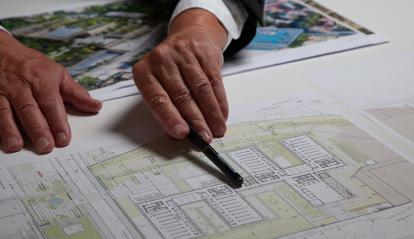
Within this framework, the building has been designed with a restrained height, arranged across three tiered floors that adapt to the slope of the terrain and blend into the landscape. “From CosmoCaixa, the view of the Collserola skyline is preserved, an architectural decision that maintains the visual connection with the natural surroundings and reinforces the project’s commitment to integration within its urban and environmental context,” explains Eduard Gascón, who highlights that throughout its development, the project took shape through continuous dialogue with Barcelona City Council.
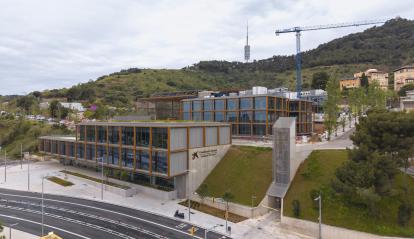
The views and the privileged setting play a fundamental role in the identity of the CaixaResearch Institute. In a city like Barcelona, and in such an exceptional location, these elements not only help attract and retain talent, but also provide research teams with an inspiring, high-quality working environment.
A
meeting point and legacy at the heart of the campus
The construction of the CaixaResearch Institute alongside CosmoCaixa has enabled the city of Barcelona to gain new gardens. This new space pays tribute to Francesc Moragas, founder of the Caixa de Pensions per a la Vellesa i d’Estalvi more than 120 years ago. His legacy endures through the ”la Caixa” Foundation, which preserves the values and social commitment that inspired the creation of the institution.
Conceived as a connecting space between the two buildings, this new nexus open to the city serves as the most iconic spot on the campus, articulated around a large, covered agora that structures the whole complex.
The architectural approach of the building is also rooted in this intention to create synergies. TAC Arquitectes explain that the idea is partly inspired by early 20th-century hospital models, organised into pavilions connected by courtyards and gardens. Between them, green spaces emerge that integrate with the architecture and reinforce a sense of a low-rise, human-scale complex adapted to the terrain. The vegetation, conceived as a structural element of the project, will gain even greater prominence over time, making the dialogue between the buildings and nature increasingly evident.
Contemporary
art by Richard Serra provides the welcome
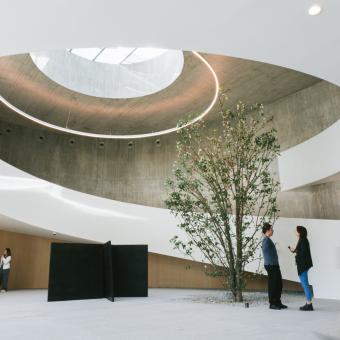
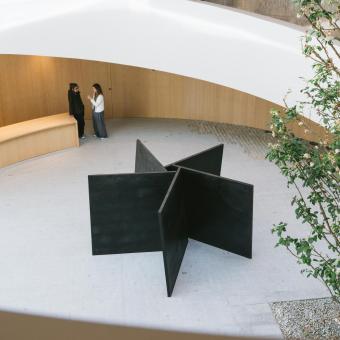
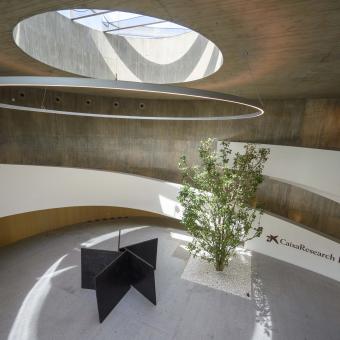
If the exterior of the CaixaResearch Institute is striking, its interior is equally remarkable. Upon crossing the threshold, visitors encounter Counter-Clockwise Pentagon, an imposing sculpture by one of the most significant visual artists of the 20th century, Richard Serra, which welcomes them into the building. The work, part of the ”la Caixa” Foundation Contemporary Art Collection, sets the tone for the space from the very first moment.
Born in San Francisco (California) in 1938, Richard Serra trained in literature and fine arts in the United States. After a period in Florence, he consolidated his sculptural vocation linked to minimalism with a body of work focused on weight, mass and gravity.
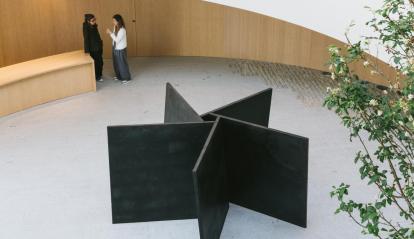
The ”la Caixa” Foundation holds three works by the artist in its collection, including this piece created in 1986. The sculpture is composed of five slightly inclined Corten steel plates balanced delicately to form a pentagon within, engaging in dialogue with a tree. The solidity of its materials, weighing up to 3,500 tonnes, evokes, within the context of the CaixaResearch Institute, the importance of robustness and stability in science.
The title refers both to its geometric form and to the anti-clockwise movement suggested by the arrangement of the plates, inviting viewers to walk around the piece and experience the space through movement. Located in the entrance hall, from which a spiral ramp leads to the upper floors, the work is not only to be observed; it is to be inhabited. It integrates the visitor as an active part of an installation which, through its presence and materiality, transforms the entrance to the CaixaResearch Institute.
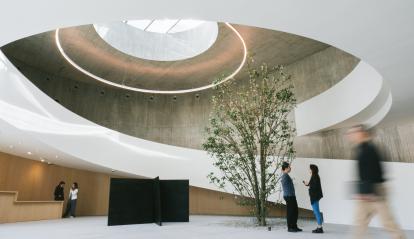
With this fusion of architecture, science and art, the CaixaResearch Institute presents itself as much more than a cutting-edge research facility. It aspires to stand alongside the great international benchmarks and to host the scientific advances that will define the coming years. More than just a building, it will be a place capable of transforming, through research, the lives of thousands of people.
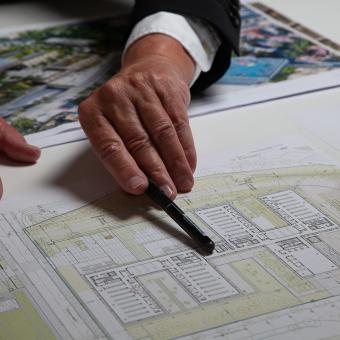
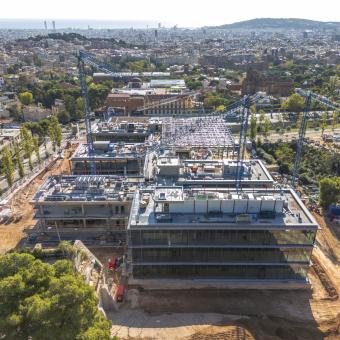
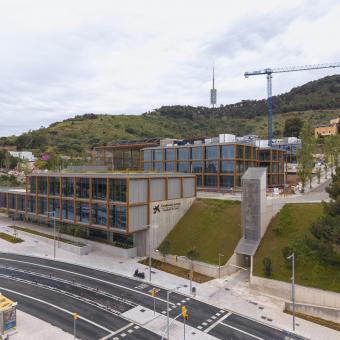
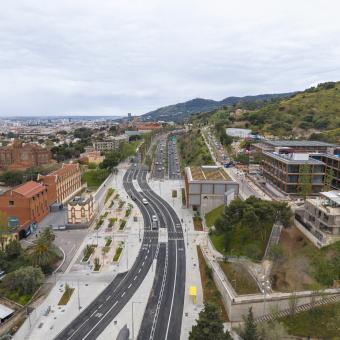
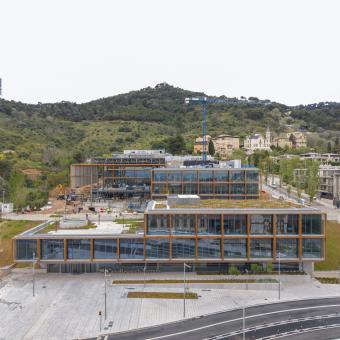
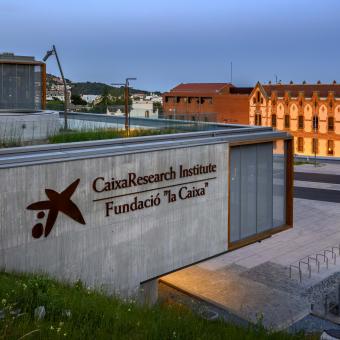
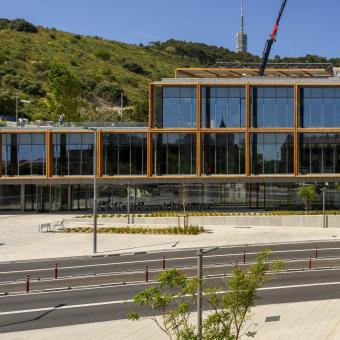
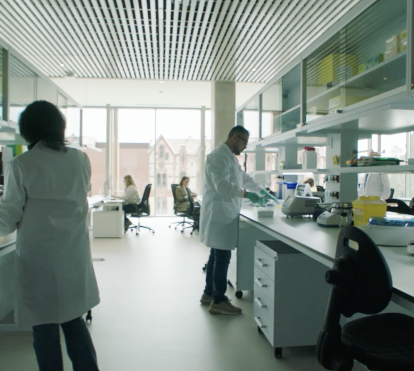
Raw images of the CaixaResearch Institute building - part 1
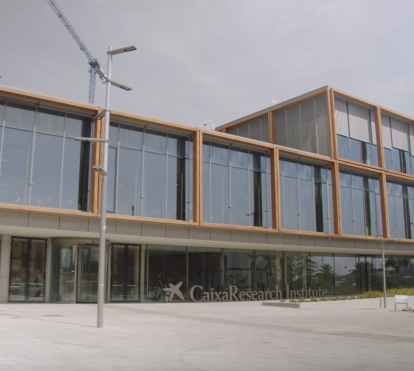
Raw images of the CaixaResearch Institute building - part 2
Raw footage of the CaixaResearch Institute building - part 1 vertical
Raw images of the CaixaResearch Institute building - part 2 vertical
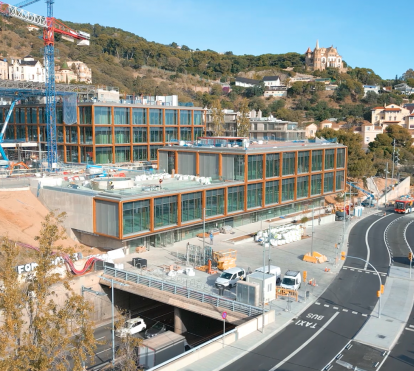
Time-lapse video of the construction of the CaixaResearch Institute
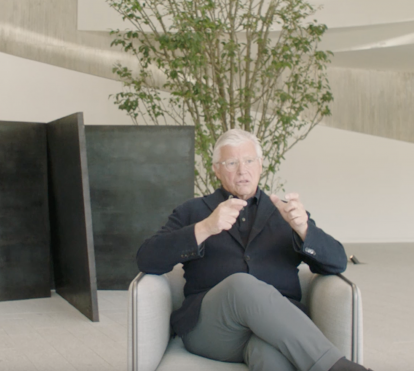
Statements by Eduard Gascón, main architect of the CaixaResearch Institute (subtitled in English)
- Imágenes
- Videos
- Audios
- Notas de prensa
Barcelona24.04.26The ”la Caixa” Foundation inaugurates the CaixaResearch Institute, the first research centre specialising in immunology in Spain and Portugal
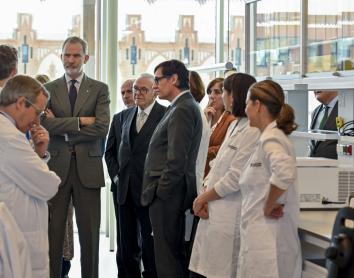
His Majesty King Felipe VI has today inaugurated the CaixaResearch Institute, the first centre dedicated entirely to the study of immunology in Spain and Portugal, and one of the first in Europe.
Read more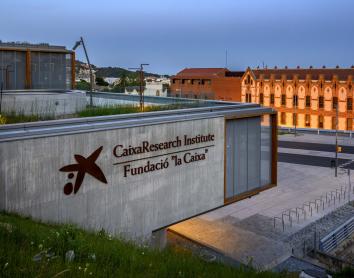
- Imágenes
Barcelona24.04.26A world-class scientific campus in Barcelona
In a global context marked by uncertainty and constant change, the synergies between the CaixaResearch Institute, CosmoCaixa and the CaixaForum network of centres will make it possible to disseminate cutting-edge research as rigorous, socially impactful science.
Read more