You are reading:
You are reading:
03.08.26
11 minutes readSend your questions to:
Professor in the
Department of Aerospace Engineering and Engineering Mechanics at The University
of Texas at Austin, where he leads the Human Centered Robotics Laboratory
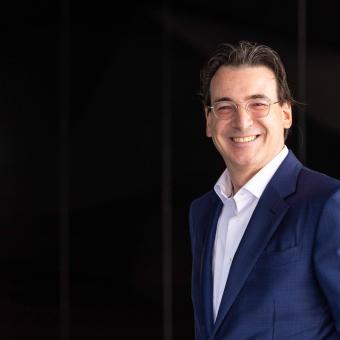
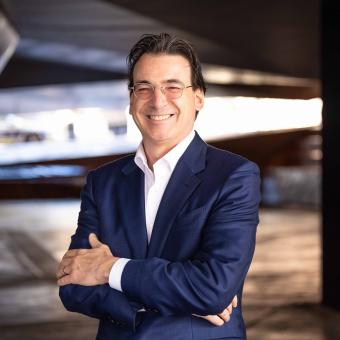
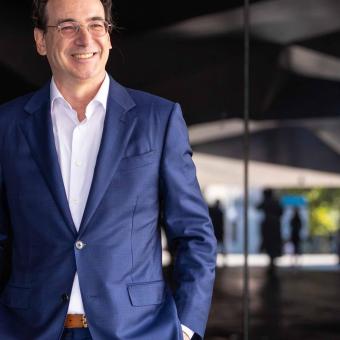
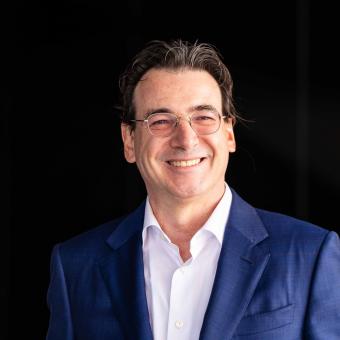
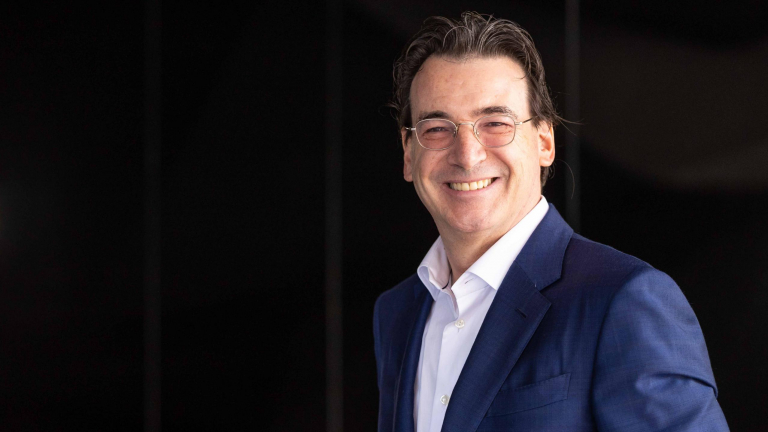
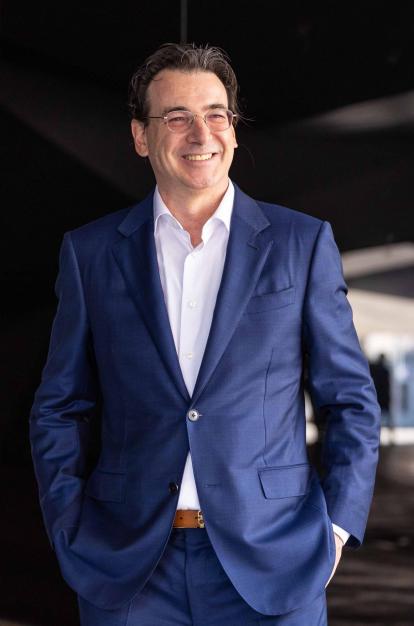
Humanoid robotics could not be understood without Luis Sentis. This Professor of Aerospace Engineering at the University of Texas and founder of the company Apptronik developed a theory that has been key to this technology the world over. In 1997, he began his postgraduate studies at Stanford University thanks to a postgraduate fellowship abroad from the ”la Caixa” Foundation. This year, he has passed the baton to a new generation of fellows by taking part in the award ceremony for the programme’s 44th edition.
You advocate a human-centred approach to robotics. What does this concept mean in practice?
My initial theory of whole-body control enabled robots to walk and manipulate objects at the same time. I’m now working on whole-body communication, in which the robot becomes an entity capable of communicating and absorbing information. As it moves through a neighbourhood, it gathers information that it can then distribute. It accumulates stories about what that place is or who lives there – all with the aim of providing a service to people.
Manipulating objects and moving around are important, but when you collaborate with others you need to communicate, and you can’t do that through a screen displaying text. There also needs to be an understanding of and an ability to anticipate what the other person is thinking… In a way, I want to understand empathy through robots. Robots need emotions to communicate better with people, not to replace them.
We also conduct research in biomimetics. How is it possible for us to play basketball or football? We’ve been fascinated with the World Cup, but what if we could create enhanced versions of the Messis and Ronaldos of the future? We don’t just want to surpass them; we want to understand how they do it. Why a muscle deteriorates with age, why we have five fingers, or why after the age of 80 almost 45% of the population cannot walk. All of this has implications for wellbeing and health, for example in the development of orthotic devices. These are fundamental physiological and anatomical questions that help us understand. And this level of detailed understanding is what defines a human-oriented robot. Humans must always be at the centre. Robots should emulate, enable the development of systems for human use, communicate with people and help a community, a town or a region to function better.
Why build robots with a human form? What are the advantages?
Legs give you speed and repeatability. They exhibit a type of system dynamics that we call exponential dynamics. If you trip over a stone, you’re launched forwards because the body’s acceleration is exponential. A car goes very fast, but it accelerates at only a fraction of gravitational acceleration. A humanoid robot or a person accelerates much faster when walking. This has advantages in certain environments.
What must a robot learn in order to move through the world with the naturalness and adaptability of a human being?
It must have a semantic understanding of the entire world and the capacity to learn. We can see this with autonomous electric cars. The major shift over the past 15–20 years is that we’ve moved away from logical rules that said, “If you encounter this intersection, path or door, you must do this,” to using probabilistic models, which comes with pros and cons.
The pro is that if the robot opens a door and encounters a new situation, it can compare it with similar situations and follow those patterns. The con is that, probabilistically, it will also make mistakes. Being infallible is impossible, but we must aim for it to be X times better than a person walking, driving or whatever the task may be. Its navigation, manipulation and other functions need to be trained, and having datasets that allow us to assess how well it’s performing is essential.
Humanoid robots have been part of the technological imagination for decades. What has changed for them to move from being a laboratory promise to a technology with real potential for deployment in factories, hospitals and homes?
Humanoids have changed radically. In the last four years alone, global investment has gone from around 40 million dollars to 40 billion. Unicorn companies have emerged that have reached valuations of one billion dollars on the stock market. This shift has been driven by very effective alignment between scientific and business leaders.
In addition, manufacturing costs have fallen dramatically. You can now have a humanoid robot for around 3,000 euros, and they come with an app store that makes many tasks easier. As a result, they’re useful and relatively affordable – we’re no longer talking about machines costing a million euros.
Apptronik has just opened a centre to train its robots through the large-scale collection of real-world data. Do robots need a school before they are ready to work alongside us?
Yes, robots need a school. At Apptronik, we have hundreds of grey-collar workers carrying out manual tasks, such as picking up a box, cutting the tape, removing the items and placing them on shelves… These datasets are extremely important.
You have had a very extensive academic career. How does one move from academic research to creating a company capable of competing in the global race for humanoid robotics?
I came to humanoid robotics out of passion, asking myself questions such as how we walk, because it’s quite extraordinary: we’re tall and slender, and yet we don’t fall over. And I soon discovered the application of that research to health and rehabilitation.
At the Universitat Politècnica de Catalunya, where I studied telecommunications engineering, I was given the opportunity to explore robotics and I began to consider pursuing a career in that field. Once in Silicon Valley, I worked in robotics, and when I started my PhD, I was able to pursue my passion for building humanoid robots thanks to the fellowship from the ”la Caixa” Foundation. Afterwards, I went on to receive funding from Honda, and my work then focused on assistive robotics, particularly for older people.
I developed the theory of whole-body control, which is now used in all humanoid robots worldwide. Then I became a professor in Austin, built a robot dedicated specifically to humanoid robotics and at the same time founded a company, after having worked with NASA on humanoids for space.
After a few years, we had secured investment of a few million. We worked for the Department of Defense, NASA and others. This has enabled us to launch development and manufacturing pipelines for hundreds of humanoids. I sometimes say that the humanoid population in Austin is growing not linearly but exponentially, and I predict that the same will happen in Barcelona and Madrid.
What lessons have you learned in this transition from researcher to co-founder of a company like Apptronik?
That it’s good to shift your focus a little. I spent 30 years centred on the laboratory, surrounded by machines and mathematics. But one day I was asked for my opinion on the use of robots in policing, and I realised I wasn’t sufficiently exposed to the social and security challenges faced by cities.
I was director of the Good Systems centre at the University of Texas at Austin, where I came into contact with journalists, writers, communicators and the general public. That marked a turning point in my career. It allowed me to focus much more on people and to understand that a technology is not justified unless it has a positive impact across all areas: employment, wellbeing and beyond.
Your developments are being tested in fields such as industry and logistics. What tasks will we see humanoid robots taking on, and where do you think they will bring the greatest benefit to society?
So far, Apptronik has focused on industry, logistics and retail, because these are very large markets. But in the social sphere we’ll see them more and more. We’re already seeing them used, for example, at trade fairs: you go to the Beijing motor show and every car presented to you is introduced by a humanoid robot. Also in shopping centres: we’ll see robots guiding visitors or promoting specific shops. On the streets – in Spain, which is a global powerhouse for tourism – imagine robots able to give directions to someone who is lost. Or in restaurants, where they could explain the menu to you.
What transformations do you think automation will bring to the labour market?
There’s a significant growth aspect to it. In the future, we’ll have more. Not more cars or more houses, but more data, more computing power, more energy at home, more servers and greater manufacturing capacity. If you have three robots, you might say: I’m going to buy a still and set up a brewery at home. Perhaps you didn’t have the time to repair the machines or the financial capacity to hire people, but with three robots, suddenly you have a service and can sell beer to your neighbours.
Everyone, regardless of their level of education or resources, will be able to become a small entrepreneur and will have a greater capacity to create products and services. Automation will not take anyone’s job away; rather, it will give each person the opportunity to create something they would not otherwise have been able to bring about.
Are we developing regulation and public debate at the same pace as technology?
There are very different models. In the United States, companies invest heavily in safety, and self-regulation predominates. It works like this: they launch a product, people take legal action against them, and they then correct the product. In Europe, by contrast, regulation is put in place before a product reaches the market, to ensure that nothing dangerous or ill-conceived is released.
Returning to your international trajectory, which began with a ”la Caixa” Foundation postgraduate fellowship to study at Stanford, what concrete opportunities did that fellowship open up for you, and how did it shape the person and researcher you are today?
The ”la Caixa” Foundation fellowship was absolutely transformative. The day after I arrived at Stanford, I was already discussing robotics with Edward Teller, the inventor of the hydrogen bomb. I later worked at a Motorola spin-off and experienced the dot-com boom and bust of 2000–2001 first-hand, a historic moment, from ground zero. I’ve also witnessed the transformation of Silicon Valley, which is an extraordinary place, and of Stanford, which was not the globally renowned university it is today. And I met people from Google who emerged from there: Elon Musk, Jeff Bezos, Eric Schmidt and others.
At the time, receiving the fellowship was a tremendous thrill for me and a personal recognition. But above all, it gives you the peace of mind and reassurance to choose a subject that truly resonates with you, to believe it can have a positive social impact, and to devote five or six years to it… I spent ten years developing a theory that would not have existed without this fellowship. I would even go so far as to say that humanoid robots might not exist without the ”la Caixa” Foundation fellowship.
After your time at Stanford, NASA, the University of Texas and Apptronik, what would you say to those who believe an international career is beyond their reach?
We all have remarkable talents. It might be creativity, the ability to connect with people, the patience to discover, the capacity to build, or strong communication skills… They shouldn’t be afraid. What matters is not IQ, but creativity and motivation.
I would tell them to think about their ideal and pursue it while they’re young. To invest in their youth and in being prepared to be surprised by the fields they’re about to enter. The fellows starting out now will go on to invent incredible things if they believe in it and go after it.
After such a well-established career, what motivates you today? What problem would you like to help solve through your work?
Right now, I’m supporting people of all ages who have novel ideas. I’m investing in young people’s startups even before they form the companies. At the same time, I’m working on the theory of whole-body communication. And I’m very interested in geopolitics. I sit on the committee of the World Forum on the Future of Democracy, AI/Tech and Humankind, led by Hillary Clinton and the Pope. I also contribute to initiatives such as the Ten Commandments of AI and the Blueprint for an AI Bill of Rights. I’m particularly interested in working with people who are developing ethical visions for the future and in helping nations that need support most.