You are reading:
You are reading:
13.01.26
8 minutes readSend your questions to:
Linguist, PhD in Computer Science, and founder of
Change Dyslexia
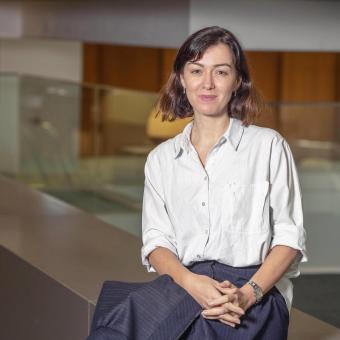
Diagnosed with dyslexia at the age of 10, Luz Rello turned the difficulties she faced with reading and writing during her school years into the driving force behind a career dedicated to researching this learning disorder. After training in linguistics and computer science, she now uses artificial intelligence for the detection and re-education of dyslexia. She is the founder of Change Dyslexia and creator of Dytective, a tool which, with the support of the ”la Caixa” Foundation, is being made available to primary schools and social organisations throughout the country. We spoke with her about her research, its social impact, and the future of dyslexia in education.
Having dyslexia didn’t affect what I initially wanted to research. I began my PhD working on natural language processing and artificial intelligence (AI). It was my thesis supervisor who, on learning about my dyslexia, suggested incorporating it into my work. Later on, it became much more relevant. When we started to obtain positive results, I wanted my research to help as many people as possible, without social barriers. That couldn’t be left to a scientific paper alone. My personal experience allowed me to empathise and to realise that, contrary to what I had thought, things in schools hadn’t changed all that much.
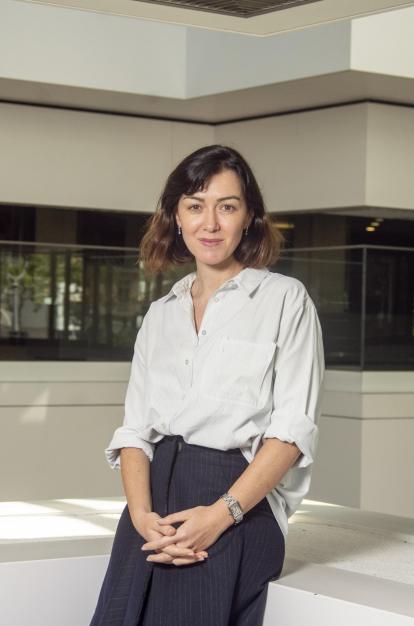
The hardest part was the emotional side: thinking you’re less intelligent than your classmates, having fewer friends, hearing laughter in class… When you can’t trust what you read or write and you don’t understand why, you lose confidence in yourself. Low self-esteem is common among people with dyslexia. Regaining it is very difficult: you have to win it back and internalise that “I can do this”.
During my PhD, a participant came into the laboratory and burst into tears before the study began. When I asked her what was wrong, she told me she’d been hit at school. That was the moment I saw myself reflected in her. I still hadn’t told anyone that I had dyslexia. I told her she would get through it, just as I had. That was when I realised there are so many of us. In my idealised view of the world, children with dyslexia no longer suffered. I was wrong! I decided that everything I did from that moment on would be in the service of people.
Yes, or it almost began there. Because, of course, you do research to be a researcher, to have a job, to discover new things. But doing research to solve a specific problem is different.
Tolerance for mistakes has become, over time, a gift. I’m very comfortable with the idea that nothing bad happens if I get something wrong. I didn’t have that resilience as a child. As an adult, when I worked in research groups with brilliant people, I noticed that if something went wrong they would jump to another topic; I, on the other hand, wouldn’t stop trying until I got it right. I wasn’t above rolling up my sleeves. In fact, when I work in a team, I always assume that if something goes wrong, the mistake is mine. Dyslexia has also taught me to trust others when you collaborate, and that’s incredibly enriching.
Change Dyslexia is a social organisation that channels all the research carried out on dyslexia. Dytective is a platform with two components: a screening test for reading and writing difficulties using AI, and a set of exercises that have been shown to significantly improve children’s literacy skills. Its effectiveness is supported by multiple scientific studies.
The breakthrough was realising that the mistakes made in writing by people with dyslexia were not random, but followed linguistic and statistical patterns, just as grammar does. It may sound trivial, but it isn’t: until then, it was thought that the errors were arbitrary, made at random. That finding gave us new information. AI models work precisely because they detect patterns, and this allowed us to apply them to personalised improvement exercises, both on a global and an individual scale. Not one of the more than 30,000 children who have used Dytective has completed the same set of exercises. Errors are manifestations of our difficulties – in dyslexia and in life – and understanding them is what enables us to tackle the problem.
We use it to predict reading and writing difficulties, and in that respect it’s very powerful. This is how it works: a person completes a set of exercises for 15 minutes, we collect almost 200 variables, and this goes into a machine-learning AI model that has previously been trained with data from thousands of people whose dyslexia diagnosis was already known. When a new participant arrives, the model identifies those patterns and predicts, with a margin of error – like any AI – whether that person is at risk of having reading and writing difficulties. In the rest of the tool, we use other personalisation techniques.
Above all, its scientific validation. Everything inside Dytective has been previously validated by researchers from different universities, which is why it has taken us 15 years to get to this point. We didn’t want to rush, nor were we driven by commercial ambition; the important thing was to solve a problem.
A study carried out by researchers from the London School of Economics and Rey Juan Carlos University shows that, in the 107 schools using Dytective in the Community of Madrid, pupils improved in the Spanish and English language tests of the Organic Law for the Improvement of Educational Quality (LOMCE). For me, it was the litmus test that proved the tool truly works.
I’m an optimist by nature, and I do think something has changed: dyslexia is increasingly less associated with being unintelligent. They used to be almost synonymous. Now I see children and teenagers openly saying they’re dyslexic, whereas when I was young you didn’t do that because you felt ashamed. I’d like neurodiversity to be recognised as a strength in the coming years.
A very important one. When you’re young and have dyslexia, you don’t know what’s happening to you and, even if someone explains it, you don’t fully understand. What you want is to get good marks, have friends and be left in peace. If no-one explains it to you from the outside, you end up thinking you’re stupid because you see others doing things without difficulty. It’s very subtle: you think it’s a matter of memory or that you’re absent-minded, because that’s what people keep telling you. That’s why having someone explain it and help you is crucial; without that, you can’t move forward.
I’m still taking it in, because it’s what I’ve always wanted. It has taken 10 years, not without difficulties, to make this project sustainable, always with the support of public administrations. The ”la Caixa” Foundation is giving us the opportunity to address the problem by enabling Dytective to be free of charge for all schools in the country. We face this with great enthusiasm and with the responsibility it entails. We need to bring about a shift in mindset within schools, just as the use of hand sanitiser became normalised in hospitals after the pandemic.
We’re currently developing those strategies. One key vehicle will be the CaixaProinfancia programme, through which the ”la Caixa” Foundation works with social organisations that support children living in vulnerable situations. We need to reach them through their schools, and there are various ways of doing so.
I’ve said it all my life, and I’m finally starting to believe it: we’re close to a systemic change in the mindset of our country. The goal is to reach a critical mass of schools that identify and address dyslexia as standard practice rather than as something exceptional, given that we represent 10% of the Spanish population.
I would tell them not to worry. For some, receiving the diagnosis is a blow, while for others it’s a relief because they finally understand they’re not stupid. The important thing is to be clear that dyslexia can be addressed. It will, however, require more effort than for others. You have to give it your all and trust the process, even if the results aren’t visible overnight. With time, you do get through it.
The key is to get informed from the very beginning. Universities usually have technology-transfer or knowledge-transfer offices, and it’s worth going to them as early as possible to understand how the process works. It also helps to look for nearby role models, lecturers or researchers who have already transferred their knowledge into a real product. I’d tell them not to think they’re on their own: there are resources and people who’ve already walked that path. At first it may seem complicated, but it can be done. You have to be persistent and also creative; it might not work the first time, or the second, or even the third, but eventually you’ll get there.