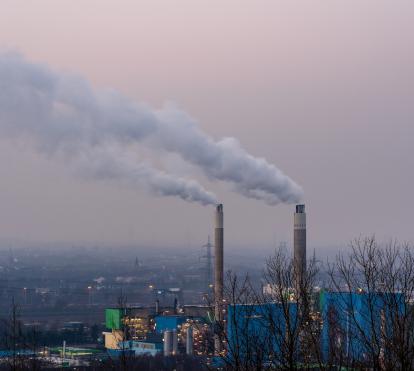
A study analyses which lung cancer subtypes are associated with different air pollutants
21.01.26
4 minutes readA study led by the Barcelona Institute for Global Health (ISGlobal), a centre supported by “la Caixa” Foundation, in collaboration with the American Cancer Society (ACS), analysed the relationship between different air pollutants and the main subtypes of lung cancer. The results were published in Environmental Pollution.
Lung cancer is mainly classified into two broad types. The most common is non-small-cell lung cancer, which includes adenocarcinoma, squamous cell carcinoma and large cell carcinoma. These subtypes differ according to the type of cells affected and their location within the lung, and they account for the majority of diagnoses. The second major type is small-cell lung cancer, which is less common but more aggressive and strongly associated with smoking.
Numerous studies have identified outdoor air pollution, particularly exposure to fine particles (PM2.5), as a lung cancer carcinogen — that is, an agent capable of causing the disease. However, the influence of air pollution on the incidence of different cancer subtypes and disease progression after diagnosis is not yet fully understood. In particular, little research has been conducted into the impact of air pollution on lung cancer survival, and this study provides valuable insight into this area.
Follow-up of up to 25 years
The study included over 122,000 people from the US Cancer Prevention Study-II (CPS-II) cohort of the American Cancer Society, beginning in 1992. Participants updated their personal data and cancer diagnoses every two years until 2017. Annual exposure to various pollutants was estimated for each participant: fine particulate matter (PM2.5), coarse particulate matter (PM10), ozone (O₃), sulphur dioxide (SO₂), nitrogen dioxide (NO₂) and carbon monoxide (CO). The analysis took into account variation in exposure over time and adjusted the results for multiple individual factors, including smoking history. Between 1992 and 2017, 4,282 cases of lung cancer were identified in this cohort.
“We used national air quality data combined with satellite and land-use information updated over the 25 years of the study,” explains Ryan Diver, an ISGlobal researcher and ACS scientist, the study’s first author. “This allowed us to relate exposure to pollution to the risk of developing different lung cancer subtypes, as well as survival after diagnosis in specific patient subgroups.”
Different pollutants, different lung cancer subtypes
The study confirmed that exposure to fine particulate matter (PM2.5) increases the risk of developing lung cancer. This effect is observed similarly across all histological subtypes, including adenocarcinoma, squamous cell carcinoma and large cell carcinoma.
The analysis also revealed significant associations with several gaseous pollutants, particularly NO₂, O₃ and SO₂, especially in non-small-cell lung cancer. Within this group, nitrogen dioxide (NO₂) showed a stronger relationship with adenocarcinoma, the most common lung cancer subtype, while ozone (O₃) was linked to a higher risk of large cell carcinoma. However, no consistent associations were found between the analysed gaseous pollutants and small-cell carcinoma, one of the subtypes most strongly associated with smoking.
Lower survival, but only in some patient groups
No clear associations were observed with regard to survival after diagnosis across the patient population as a whole. However, among patients with early-stage disease, SO2 was associated with lower survival rates.
“We have observed that air pollution is not associated with all types of lung cancer in the same way,” explains Michelle C. Turner, an ISGlobal researcher and the paper's senior author. “Our results reinforce the importance of integrating local air quality into healthcare plans and assessing each patient’s environmental exposure to identify additional risks,” Turner concludes.
Reference
Diver, W. R., Teras, L. R., Deubler, E. L., Flanders, W. D., Wang, Y., Liang, D., Patel, A. V., & Turner, M. C. (2025). Association of ambient air pollutants with risk of lung cancer subtypes and survival after diagnosis. Environmental Pollution (Barking, Essex: 1987), 390(127456), 127456. https://doi.org/10.1016/j.envpol.2025.127456


- Imágenes
Barcelona20.11.25Forecaster.Health Now Issues Health Alerts of Air Pollution for Vulnerable Populations
The Forecaster.health early warning system now includes a new feature: the ability to anticipate mortality associated with air pollution in Europe.
Read more
- Imágenes
Barcelona16.10.25Air pollution during pregnancy is associated with slower brain maturation in newborns
A study published in Environment International concludes that air pollution during pregnancy is associated with slower brain maturation in newborns.
Read more