A protein in brain immune cells could accelerate neuronal damage in Alzheimer’s disease
20.11.26
4 minutes readAn international study involving the CaixaResearch Institute reveals a potential mechanism linking inflammation to the formation of amyloid plaques through galectin-3.
Alzheimer’s disease is characterised by the accumulation in the brain of fragments of a protein called amyloid beta (Aβ), which clump together to form plaques. These plaques are one of the main hallmarks associated with the disease. The brain has its own immune cells, known as microglia, which are able to respond to these plaques. This response can protect brain tissue, but can also damage it.
The study, co-led by Lluís Camprubí-Ferrer of Lund University (Sweden) and Dr Gabriel Rabinovich of the CaixaResearch Institute, together with Dr Tomas Deierborg (Lund University), Dr José Luis Venero (University of Seville) and Dr Antonio Boza (University of Seville), suggests that the protein galectin-3 may modulate both the progression of amyloid plaques and the microglial response to them.
“These findings not only reveal a novel mechanism regarding the role of galectin-3 as a link between amyloid beta and microglial activation, but also have translational impact by supporting the relevance of this lectin as a new therapeutic target for the treatment of Alzheimer’s disease,” explains Dr Gabriel Rabinovich, head of the Glycoimmunology Laboratory at the CaixaResearch Institute and the Institute of Biology and Experimental Medicine (IBYME-CONICET, Argentina).
A protein that acts on two fronts
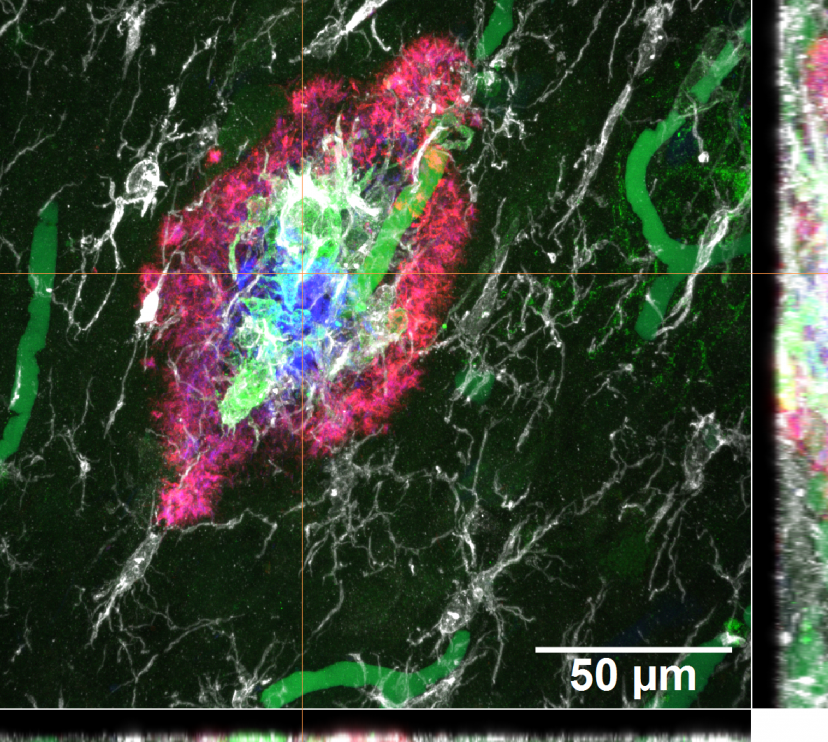
Galectins are a family of proteins capable of regulating the immune response. The new study, published today in Proceedings of the National Academy of Sciences of the United States of America (PNAS), shows that galectin-3 acts simultaneously on two fronts. On the one hand, outside the cells, it binds to the plaques and modifies the shape of the amyloid fibres as they grow. On the other, within microglia, it controls how amyloid is processed in lysosomes, the cell compartments responsible for cleaning up and recycling cellular material.
The researchers observed that galectin-3 binds to amyloid fibres and blocks one of the steps that enables the fibres to multiply, altering their shape. In cell experiments, these altered fibres continued to damage nerve cells. This is a process that had not previously been observed.
When the researchers removed galectin-3 in a mouse model of Alzheimer’s disease, the amyloid plaque burden was reduced and damage to nerve endings also decreased. In addition, the microglial cells shifted from an aggressive inflammatory state to a protective state, with higher levels of the TREM2 receptor, a protein known to play a major role in the brain’s immune defences and in the risk of developing Alzheimer’s disease. When analysing brain tissue from people with the disease, the researchers observed the same association between galectin-3, amyloid plaques and neuronal damage.
A new therapeutic target
The findings of this study point to galectin-3 as a potential therapeutic target for the development of future treatments for Alzheimer’s disease, a condition which currently has no cure and is diagnosed in seven million new cases worldwide each year.
Although the results in animal models and human brain tissue are promising, further research is still needed to determine the extent to which blocking galectin-3 could benefit people living with Alzheimer’s disease.
Throughout his career, Dr Rabinovich’s research has enabled him to identify and characterise the role of galectins, proteins that can modulate the immune response and promote mechanisms associated with tumour growth and the resolution of inflammatory diseases. He is currently developing new immunotherapies based on these mechanisms.
About the CaixaResearch Institute
The CaixaResearch Institute is the first research centre in Spain and Portugal dedicated entirely to the study of immunology. Based in Barcelona and backed by the ”la Caixa” Foundation, the centre focuses its research on immune processes, their interaction with the most prevalent diseases and the environmental factors that influence them. Through an interdisciplinary approach combining fundamental and translational research with advanced technologies, the CaixaResearch Institute aims to generate new knowledge and contribute to the development of new tools for prevention, diagnosis and treatment that improve people’s health.
Reference article

- Imágenes
- Videos
- Audios
Barcelona14.09.26When the immune system turns against us: living with multiple sclerosis
Multiple sclerosis is a neurological disease in which the immune system, designed to protect the body, becomes its main aggressor. More than 55,000 people are living with it in Spain.
Read more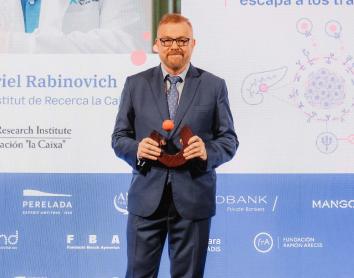
- Imágenes
Barcelona09.06.26Gabriel Rabinovich receives the 5th Dr Baselga FERO Grant to develop new immunological strategies against pancreatic cancer
Gabriel Rabinovich, a researcher at the CaixaResearch Institute, has been awarded the 5th Dr Baselga FERO Grant to develop a project focused on identifying new immunological strategies for pancreatic cancer.
Read more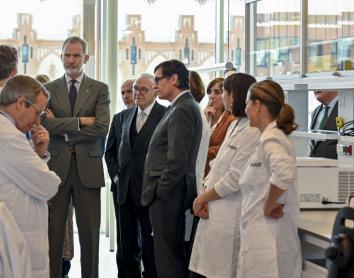
- Imágenes
- Videos
- Audios
- Notas de prensa
Barcelona24.04.26The ”la Caixa” Foundation inaugurates the CaixaResearch Institute, the first research centre specialising in immunology in Spain and Portugal
His Majesty King Felipe VI has today inaugurated the CaixaResearch Institute, the first centre dedicated entirely to the study of immunology in Spain and Portugal, and one of the first in Europe.
Read more